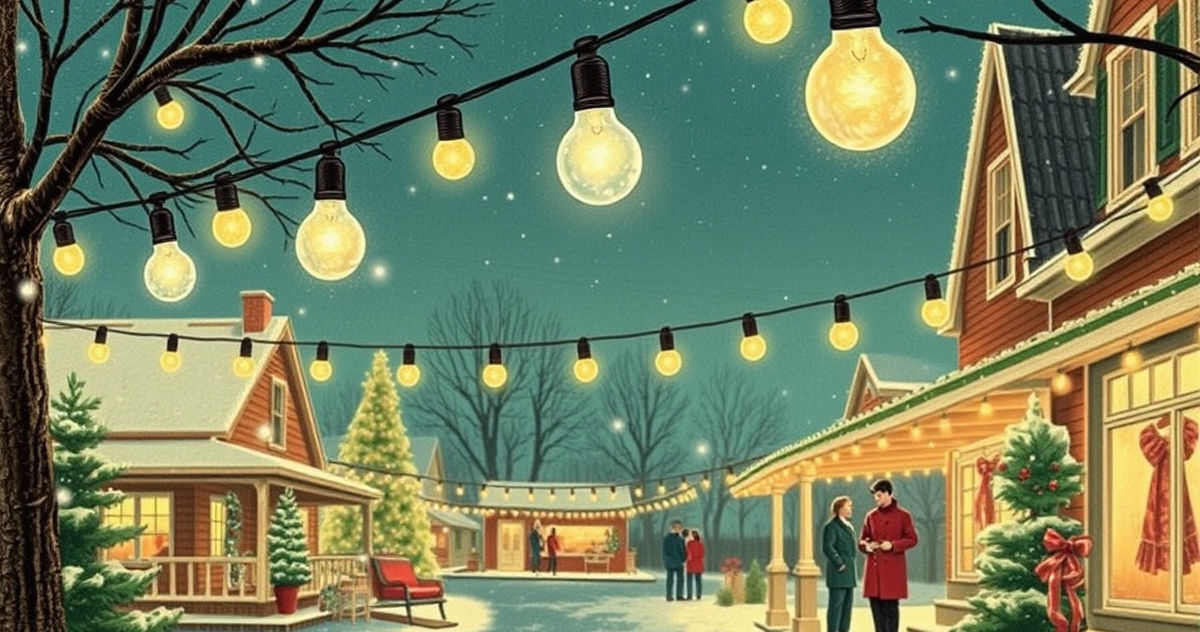
Imagine standing on a wooden boardwalk in 1880, the salt air thick around you, when suddenly hundreds of small glass globes flicker to life overhead — a sight so otherworldly that onlookers reportedly gasped and reached out to touch the warm glow. That moment, engineered by Thomas Edison along the Coney Island shoreline and at his Menlo Park laboratory, wasn't just a technical triumph. It was the birth of a tradition that today lights up millions of American homes, storefronts, town squares, and backyard celebrations every single year. The outdoor string light — humble, joyful, endlessly versatile — has one of the most fascinating evolutionary stories in decorative history.
Edison's Spark: The First Public String Lights (1880)
Thomas Edison didn't invent the light bulb in isolation. He invented a system — generators, wiring, sockets, and bulbs designed to work together at scale. By 1880, just a year after his famous incandescent breakthrough, Edison strung hundreds of glass bulbs along the grounds of his Menlo Park laboratory in New Jersey, creating what historians widely regard as the first outdoor decorative electric lighting display. Journalists who witnessed it described the scene as "fairyland made real."
Edison then took his illumination spectacle public. His collaboration with Coney Island's developing boardwalk scene introduced mass audiences to the concept of outdoor electric light as entertainment. The warm, amber glow of those carbon filament bulbs — the direct ancestors of today's warm white C9s — transformed night into an attraction. People traveled specifically to see the lights. The concept of "going out at night because somewhere beautiful is lit up" was born right there on that boardwalk.
It's worth noting that Edison's early string configurations were crude by modern standards — heavy, fragile, and powered by generators that required constant tending. But the visual impact was undeniable, and the commercial possibilities were immediately obvious to entrepreneurs and city planners alike. You can trace an unbroken line from those boardwalk bulbs to the professional-grade displays we install for Pennsylvania homes and businesses today.
Amusement Parks and the Festive Outdoor Bulb Strand (Early 1900s)
The early twentieth century saw Edison's concept explode outward into American popular culture, largely through the boom in amusement parks. Coney Island, Atlantic City's boardwalk (right next door to Pennsylvania), and parks like Chicago's White City in 1893 used thousands of outdoor bulbs to create immersive nighttime environments. These weren't just functional lights — they were spectacle, architecture, and emotion all woven together in glowing wire.
Park designers discovered that stringing bulbs in festive patterns — along rooflines, wrapped around towers, draped between structures — created a sense of magic and celebration that daytime visitors simply couldn't experience. The pattern of bulbs spaced along a single wire, what we now universally recognize as the classic "string light," became the dominant form. Carnival operators nicknamed them "party strands," a term that survives in casual conversation to this day.
By the 1910s and 1920s, residential adoption began, though slowly. Electricity itself was still a luxury in many American homes. Neighbors would gather on porches to admire a single strand of outdoor bulbs strung on a porch railing. Department stores began selling "outdoor festoon strings" in their holiday catalogs. The cultural association between string lights and celebration — Christmas, summer evenings, weddings, fairs — was cementing itself deeply into American identity.
If you love the way historic Victorian-era Pennsylvania homes look draped in warm lighting, you're actually experiencing the direct legacy of this amusement park era. The visual language of those early carnival designers is still very much alive.
The Mid-Century Evolution: Tungsten, Colored Glass, and the Rise of the C9
The 1930s through 1960s brought a revolution in bulb technology that shaped the outdoor string light into the form most older Americans still picture when they close their eyes. Carbon filament gave way to tungsten — a far more durable, brighter, and longer-lasting material. This change made bulbs cheaper to manufacture and more reliable for outdoor use, opening string lights to the mass consumer market in an entirely new way.
It was during this period that colored glass bulbs rose to prominence. Manufacturers discovered that tinting glass during production created rich, saturated reds, blues, greens, and golds that carbon filament bulbs had never achieved effectively. The C9 bulb — that large, faceted, strawberry-shaped globe — became the defining icon of mid-century outdoor Christmas and festive lighting. C9s offered a dramatic, jewel-like presence that smaller bulbs simply couldn't match, and their warm white and colored variants became synonymous with the American holiday front yard.
Post-World War II prosperity meant more homeowners, more electrically wired homes, and a booming suburban culture hungry for ways to celebrate and compete neighborly on the question of holiday décor. Hardware stores stocked C9 strings by the season. GE and Westinghouse marketed outdoor bulb kits in their holiday advertising. By the 1950s, roofline lighting with C9s had become a true American tradition — and one that Pennsylvania neighborhoods embraced enthusiastically.
Today's professional-grade C9 bulbs are the refined descendants of those mid-century icons. Our complete guide to C9 bulb colors, styles, and installation in Pennsylvania walks through every option available to modern homeowners who want that classic look with contemporary reliability.
Mini Lights Enter the Scene: The 1970s and 1980s Revolution
If C9s were the bold statement of mid-century lighting, Mini Lights were the democratic revolution that followed. Developed in Asia in the late 1960s and popularized throughout North America in the 1970s, mini lights — those tiny, rice-shaped bulbs wired in close series — brought outdoor string lighting within reach of virtually every household budget.
The sheer density of mini lights changed what was visually possible. Where C9 strands created bold, spaced constellations of color, mini lights could wrap trees, bushes, and architectural details in continuous blankets of warm white or multicolored glow. The 1980s and 1990s saw an absolute explosion of mini light creativity: spiraled tree trunks, wrapped shrubs, icicle-style roof drips, net lighting over garden beds. American front yards became canvases.
Mini lights also introduced a new problem: they could fail in series, causing entire strands to go dark from a single bad bulb. The frustrating ritual of testing individual bulbs became a holiday tradition of its own sort — a less beloved one. This frustration, more than any other single factor, created the demand for the technology that would transform outdoor string lighting forever.
The versatility of mini lights remains extraordinary even today. Our post on 10 creative uses for mini lights beyond Christmas trees showcases how this classic product continues to inspire decorators across Pennsylvania.
The LED Revolution: String Lights Reimagined for the 21st Century
Light-emitting diode technology had existed in laboratory settings for decades, but it wasn't until the early 2000s that LED string lights became commercially viable for outdoor decorative use. The transformation was swift and comprehensive. Within a single decade — roughly 2000 to 2010 — LEDs went from novelty to dominant technology, and for very good reasons.
LED string lights consume up to 80% less electricity than their incandescent equivalents. They run dramatically cooler, reducing fire risk and making them safe to use on live trees, fabric, and other materials where hot incandescent bulbs were genuinely dangerous. They last tens of thousands of hours — meaning a quality LED Mini Light strand installed today could still be performing beautifully a decade from now. And because LEDs don't fail in the series-dependent way older mini lights did, the era of the dreaded "dead strand investigation" effectively ended.
For Pennsylvania homeowners especially, LED string lights offered another crucial advantage: cold-weather performance. Traditional incandescent bulbs dimmed and flickered in sub-freezing temperatures. LEDs actually perform better in cold conditions, making them ideal for our Pennsylvania winters where displays need to shine reliably from Thanksgiving through New Year's regardless of what the weather delivers.
The LED era also expanded the color palette available to decorators. Precision manufacturing means today's warm white LEDs can be tuned to exact color temperatures — from the golden candlelight warmth of 2700K to the crisp, cool brilliance of 5000K — a level of control that Edison's carbon filament bulbs could never approach. Our project gallery showcases the full range of effects that modern LED technology makes possible across Pennsylvania properties.
For a deeper dive into how this electrical evolution connects to holiday traditions specifically, our post on the history of electric Christmas lights from Thomas Edison to modern LEDs provides a wonderful companion read.
String Lights Today: Year-Round Celebration and Professional Design
The story of outdoor string lights is ultimately a story about human beings' desire to extend beauty and celebration into the darkness. From Edison's gasping boardwalk crowds to today's Instagram-worthy backyard wedding receptions strung with warm white Mini Lights, the emotional core has never changed. What has changed is accessibility, safety, efficiency, and creative possibility.
Modern outdoor string light installations have become sophisticated design projects. Professional designers consider bulb spacing, color temperature, structural attachment points, power load management, weather sealing, and long-term maintenance. A well-designed string light installation on a Pennsylvania home or commercial property isn't just decoration — it's architectural enhancement that adds genuine curb appeal and property value year-round.
Pennsylvania's decorating culture has always embraced this tradition enthusiastically. From the historic brick rowhouses of Philadelphia to the Victorian Painted Ladies of Jim Thorpe, from the mountain cabins of the Poconos to the manicured suburban lawns of the Main Line, outdoor string lights speak a universal language of welcome and warmth. Our guide to summer wedding string lighting at Pennsylvania outdoor venues demonstrates just how far the application of this century-old technology has expanded beyond its holiday origins.
Whether you're drawn to the bold, classic presence of C9 bulbs along your roofline — honoring that proud mid-century tradition — or you prefer the delicate, dense magic of Mini Lights wrapped through your landscaping, you're participating in a living tradition that stretches back to Thomas Edison standing in a New Jersey field, watching his new invention flicker to life against the dark.
If you're ready to bring that tradition to your own Pennsylvania property with the expertise and equipment it deserves, contact our team at Holiday Lights Decor Pennsylvania or call us at (908) 336-2625 to discuss a custom installation. Our professionals have been designing and installing outdoor lighting displays across Pennsylvania since 2006 — and we'd love to help write the next chapter of your property's glowing story.
Frequently Asked Questions
Did Thomas Edison actually invent the outdoor string light?
Edison didn't patent a "string light" as we know it today, but he absolutely pioneered the concept. His 1880 outdoor illumination displays at Menlo Park and along the Coney Island boardwalk — where bulbs were strung together on wires and powered by a central generator — are widely considered the first public outdoor decorative electric lighting. The festive strand concept grew directly from those early installations.
What is the difference between C9 bulbs and Mini Lights for outdoor use?
C9 bulbs are large, faceted glass globes typically spaced 12 inches apart on heavy-gauge wire. They create bold, widely-spaced points of light ideal for rooflines, large trees, and architectural outlines. Mini Lights are small, densely-spaced bulbs that create a continuous carpet of glow — perfect for wrapping trees, bushes, garlands, and railings. Both are available in warm white and a range of colors, and both now come in energy-efficient LED versions. The best choice depends on your specific design goals.
Are LED string lights really better than traditional incandescent for Pennsylvania's climate?
Yes, significantly so. LEDs perform better in cold temperatures — unlike incandescent bulbs, which can dim and flicker in freezing conditions. They also consume up to 80% less electricity, run cool to the touch (reducing fire risk), and last dramatically longer. For Pennsylvania winters where displays need to perform reliably through snow, ice, and temperature swings, LEDs are the clear professional choice.
When did colored outdoor string lights become popular?
Colored glass outdoor bulbs became widely popular in the 1930s and 1940s, coinciding with the shift from carbon filament to tungsten technology. Tungsten's higher operating temperature allowed for more vibrant colored glass tinting. The post-World War II suburban boom of the late 1940s and 1950s drove mass adoption of colored C9 string lights for holiday outdoor displays, cementing the tradition that millions of American families still follow today.
Can outdoor string lights be used year-round, or are they just for holidays?
Modern LED outdoor string lights are absolutely designed for year-round use. The technology is weatherproof, energy-efficient, and durable enough for permanent outdoor installation. Many Pennsylvania homeowners use warm white Mini Lights on patios, pergolas, and landscaping throughout spring, summer, and fall — then transition to holiday-specific configurations in winter. Year-round string light installations add consistent beauty and value to a property in every season.