Key Takeaways
- Summer is the optimal window for Pennsylvania property managers to assess display zones, draft RFPs, and lock in professional holiday lighting contracts before October availability dries up.
- Roofline C9 bulbs, entrance garlands, and parking area lighting each require separate planning — square footage, power access, and local code compliance all factor in before a single strand goes up.
- ADA-compliant pathway and entrance lighting isn't optional for commercial properties; it protects tenants, visitors, and your liability exposure throughout the holiday season.
- Cool white LEDs reinforce corporate professionalism; warm white creates hospitality warmth — your brand identity should drive the color temperature decision before you write a single line in your RFP.
- A well-structured RFP for professional holiday lighting in Pennsylvania protects your budget, sets clear deliverables, and attracts experienced contractors who understand commercial-scale installations.
The last week of October is the worst possible time to realize your Class A office park in suburban Philadelphia or your mixed-use building in Pittsburgh still doesn't have a holiday lighting contract. Experienced contractors are fully booked, premium time slots are gone, and the C9 bulb garlands and fresh wreaths you envisioned for the entrance canopy are an afterthought instead of a centerpiece. Pennsylvania property managers who treat holiday lighting as a summer planning item — not a fall fire drill — consistently end up with better displays, safer installations, and lower per-square-foot costs. This checklist walks you through everything you need to do between now and September to ensure your building shines all season.
Why Summer Is the Right Season to Plan Office Building Holiday Lights in Pennsylvania
Professional holiday lighting contractors in Pennsylvania typically fill their commercial installation calendars between August and early October, leaving very little flexibility for property managers who wait until November. Booking early isn't just about availability — it's about giving your design team enough runway to execute a display that actually fits your building's architecture, brand standards, and budget.
- Material lead times: Commercial-grade C9 bulbs, custom-cut garland runs, and exterior wreaths sized for oversized entrance doors often require 6–10 weeks of lead time from specialty suppliers, especially for bulk orders.
- Permit coordination: Some Pennsylvania municipalities require permits for large commercial lighting installations on public-facing facades or for rooftop electrical work. Submitting in September beats a November scramble.
- Budget approval cycles: Most commercial property budgets finalize Q3. Having a signed contract and a line-item cost before October 1 is far easier than an emergency requisition.
- Site assessment scheduling: Contractors can walk your property in daylight during calm weather — not on a cold November afternoon — when summer planning is the norm.
For a deeper look at why advance scheduling pays off, see our post on restaurant holiday decor planning and summer booking in Pennsylvania, which covers similar timeline pressures for hospitality properties.
Assessing Your Building's Display Zones: Roofline, Entrance, and Parking
A thorough display zone assessment is the foundation of every successful commercial holiday lighting project, and it should happen before you contact a single contractor. Walk your property with a measuring tape, a phone camera, and a checklist covering three distinct zones.
Roofline
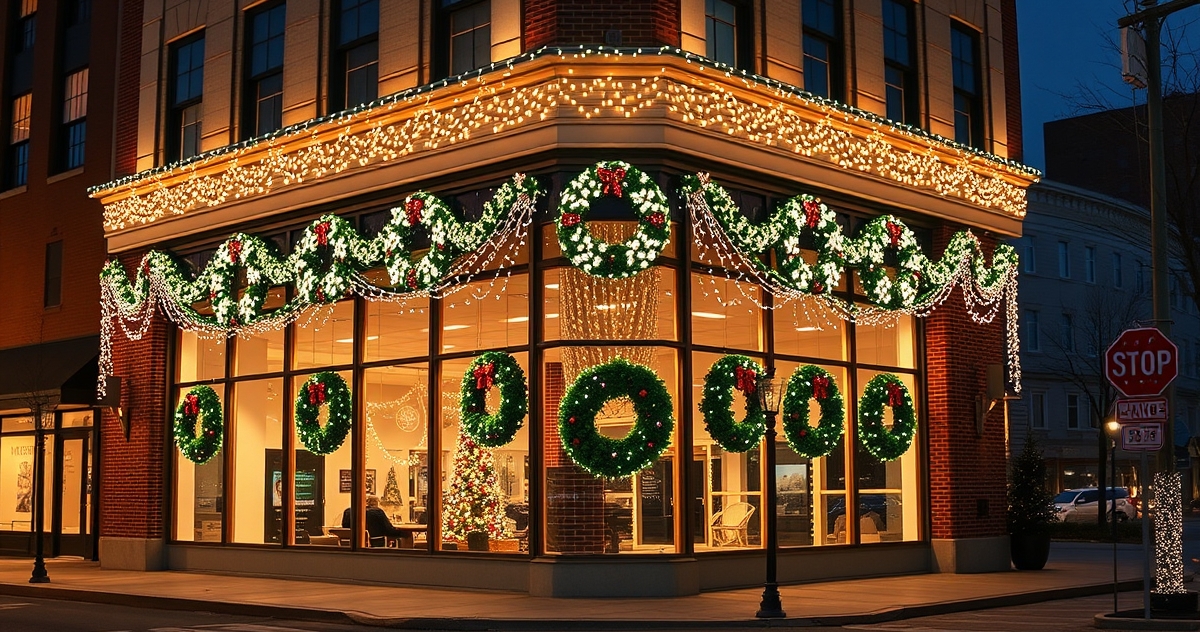
The roofline is the highest-visibility zone for any office building, visible from the street, the parking area, and neighboring properties. C9 bulbs on commercial-grade stringers are the industry standard for roofline applications — their 7-watt LED equivalents provide brilliant output at roughly 80% less energy consumption than traditional incandescent versions. When assessing your roofline, document:
- Total linear footage of eaves, ridgelines, and parapet walls
- Existing anchor points or conduit runs from prior installations
- Roof access routes and any safety tie-off requirements under OSHA fall-protection standards
- Distance from nearest dedicated exterior electrical circuits
Our roofline lighting guide for C9 bulbs covers installation fundamentals that apply equally to commercial facades.
Entrance and Canopy
Your building's entrance is where tenants, clients, and visitors form their first impression of the holiday season. This zone typically combines multiple product types: fresh or commercial-grade artificial garlands wrapped around columns, large-format wreaths (36-inch to 60-inch diameter for commercial doors), and accent lighting that highlights architectural details. Measure column circumferences, door widths, and canopy spans. Note whether your entrance has a weather-protected area where fresh greenery can survive — or whether UV-stable artificial garland is the smarter investment.
Parking Area and Perimeter
Parking lot lighting is often overlooked in holiday display planning, but it directly affects the perception of safety and festivity for anyone arriving after dark — which in Pennsylvania means everyone who shows up after 5 PM from November through January. Document existing pole heights, spacing between poles, and current fixture types. Pole-wrap garlands, C9 string drops from pole to pole, and illuminated bows at the tops of light poles are all commercially viable options that transform a utilitarian parking area into an inviting space.
ADA-Compliant Pathway and Entrance Lighting for Commercial Properties
ADA compliance for commercial holiday lighting means ensuring that decorative installations never obstruct accessible pathways, reduce required illumination levels, or create tripping hazards at entrance points — and Pennsylvania property managers are legally responsible for maintaining those standards throughout the entire display season.
The Americans with Disabilities Act requires a minimum 36-inch clear width on accessible routes. During holiday installations, garland swags, extension cord runs, and stake-mounted pathway lights must be routed completely outside that corridor. Key compliance considerations include:
- Ground-level clearance: No decorative element — stakes, wire clips, or low-hanging garland — should project into accessible walkway zones. Bury or channel all wiring beneath pavement plates rated for pedestrian traffic.
- Maintained illumination levels: Holiday lighting is supplemental, not a replacement for existing safety lighting. Ensure decorative strings don't shadow accessible parking signage, ramp markings, or threshold transitions.
- Entrance door clearance: Wreaths mounted on door hardware must not impede automatic door operation or reduce door width below ADA minimums. Side-mount brackets that keep wreaths against glass panels — rather than hanging from door mechanisms — are the compliant solution for commercial entrances.
- Seasonal maintenance accountability: Assign a specific team member to inspect the accessible route daily during the display season. Pennsylvania winters mean ice, shifted stakes, and fallen garland sections require fast corrective action.
Professional installers familiar with commercial holiday lighting services in Pennsylvania will incorporate ADA route documentation directly into their installation plans — ask for it explicitly in your RFP.
Cool White vs. Warm White: Matching Light Temperature to Your Brand
The choice between cool white and warm white LED holiday lighting is one of the most consequential aesthetic decisions a Pennsylvania property manager makes, and it deserves more deliberation than most buildings give it. Color temperature directly shapes how visitors perceive your property's brand identity during the holiday season.
| Light Color | Color Temperature | Brand Association | Best Application |
|---|---|---|---|
| Cool White | 5000–6500K | Corporate, modern, precision, technology | Class A office towers, financial services, tech campuses, law firms |
| Warm White | 2700–3200K | Hospitality, approachable, cozy, traditional | Mixed-use retail/office, hospitality, medical offices, boutique properties |
| Neutral White | 3500–4000K | Balanced, professional, versatile | Multi-tenant office parks with mixed industry tenants |
Cool white LEDs on C9 bulb roofline runs deliver a crisp, architectural quality that reads extremely well against Pennsylvania's gray winter skies — they photograph beautifully for property marketing materials and reinforce a polished, premium brand image. Warm white, by contrast, creates the amber glow associated with holiday tradition; it's the right choice for entrance garlands at properties where you want visitors to feel welcomed and comfortable the moment they step out of their car.
Many commercial properties in Pennsylvania use a deliberate split: cool white on the roofline and exterior facade for visibility and brand authority, warm white on entrance columns, garland accents, and interior lobby displays for human warmth. This layered approach is worth discussing with your contractor during the design phase. For related color strategy guidance, see our article on blue and white winter themes with elegant LED effects.
How to Write an RFP for Professional Holiday Lighting Services in Pennsylvania
A well-structured Request for Proposal (RFP) for commercial holiday lighting protects your budget, filters out unqualified bidders, and gives you a consistent basis for comparing contractor proposals. Here's the structure that works for Pennsylvania commercial properties.
Section 1: Property Overview
Include building square footage, number of stories, total linear roofline footage (from your zone assessment), parking lot dimensions, and any access restrictions (security badging, loading dock hours, HVAC equipment near rooflines). Attach your site map.
Section 2: Scope of Work
Be specific. Describe each zone and what you want installed — for example: "120 linear feet of C9 cool white LED roofline lighting on the south and east facades; four 48-inch commercial wreaths with warm white integrated lighting at main entrance; garland wrapping on six entrance columns, approximately 8 feet each." Vague scopes produce wildly varying bids that can't be compared apples to apples.
Section 3: Installation, Maintenance, and Removal Requirements
Specify your target installation completion date (November 15 is a common commercial benchmark in Pennsylvania), the display period end date, and your expected takedown and storage timeline. Require that the contractor provide all labor, equipment, and hardware — and that all electrical connections comply with Pennsylvania's Uniform Construction Code. Ask explicitly whether removal and storage services are included or priced separately.
Section 4: Insurance and Compliance Requirements
Require a minimum of $1 million in general liability coverage and workers' compensation insurance current in Pennsylvania. Request proof of OSHA fall-protection compliance for any rooftop work. Ask for at least three commercial references in Pennsylvania with comparable property scale.
Section 5: Pricing Structure
Request itemized pricing by zone, separate line items for materials versus labor, and clear pricing for any mid-season emergency service calls. Ask whether the contractor owns its inventory (better) or rents product (more variable quality).
For more context on what professional commercial installations involve, explore our commercial holiday lighting services page.
Your Summer Planning Checklist: Month by Month
Use this phased checklist to keep your office building holiday lighting project on track from summer through installation day.
June – July: Assessment and Budget
- Complete your three-zone site assessment (roofline, entrance, parking)
- Photograph all display zones in good daylight conditions
- Pull prior-year invoices to establish a baseline budget
- Confirm available exterior electrical circuits and amperage with your facilities team
- Review ADA route documentation for the property
- Confirm tenant communication plan for installation dates
August: RFP and Contractor Outreach
- Draft and distribute your RFP to at least three qualified Pennsylvania lighting contractors
- Set a proposal deadline of mid-August to allow time for review
- Schedule walkthrough appointments with bidding contractors
September: Selection and Contract Execution
- Review bids, check references, and confirm insurance certificates
- Select your contractor and execute a signed contract with payment milestones
- Confirm material specifications — C9 bulb color temperature, garland type, wreath sizes
- Lock in installation date and building access logistics
- Submit any required municipal permits
October – November: Pre-Installation and Installation
- Confirm materials have arrived and inspect for damage
- Notify tenants of installation schedule and any temporary access changes
- Conduct post-installation walkthrough with contractor against your zone specification
- Test all circuits and timers; confirm ADA routes are fully clear
See our guide on spring maintenance for holiday light infrastructure for how to extend your investment into the following year.
Frequently Asked Questions
When should Pennsylvania property managers book holiday lighting contractors for office buildings?
Pennsylvania property managers should book professional holiday lighting contractors by September 1 at the latest — and ideally by August 1 for large commercial properties. Commercial installers in Pennsylvania typically fill their prime November installation windows by early October, and popular products like commercial-grade C9 LED stringers and 48-inch wreaths can have 6–10 week lead times. Summer booking also allows time for permitting, tenant notification, and design revision cycles without the pressure of an approaching deadline.
What is the difference between cool white and warm white holiday lights for office buildings?
Cool white LED holiday lights (5000–6500K) produce a crisp, bright, bluish-white glow that aligns with corporate, financial, and technology brand identities — they look sharp on roofline C9 runs and modern architectural facades. Warm white LEDs (2700–3200K) produce an amber, traditional glow that feels welcoming and cozy, making them the preferred choice for hospitality properties, mixed-use buildings, and entrance garland accents. Many Pennsylvania commercial properties use cool white on the exterior roofline and warm white on entrance-level garlands and wreaths to layer both effects.
Are there ADA requirements that affect commercial holiday lighting installations in Pennsylvania?
Yes. The Americans with Disabilities Act requires that all accessible routes maintain a minimum 36-inch clear width, and commercial holiday lighting installations must not obstruct that corridor at any point during the display season. Extension cord runs must be channeled beneath pedestrian-rated floor plates, low-hanging garland must not project into walkways, and entrance wreaths must be mounted so they don't reduce door clearance or impede automatic door operation. Pennsylvania property managers are responsible for daily inspection of accessible routes throughout the holiday season to address any installation shifts caused by weather or foot traffic.
What products are most commonly used for commercial office building holiday displays?
The three core products for office building holiday lighting in Pennsylvania are C9 LED bulbs on commercial-grade stringers (for rooflines, parapet walls, and parking pole wraps), commercial-scale garlands (for column wrapping, entrance canopies, and railing draping), and oversized wreaths in 36-inch to 60-inch diameters (for entrance doors and facade focal points). All three are available in commercial-grade versions engineered for Pennsylvania's freeze-thaw winter cycles, with UV-stable materials that maintain color integrity through January takedown.
How detailed does an RFP for holiday lighting need to be for a commercial property in Pennsylvania?
A commercial holiday lighting RFP in Pennsylvania should include a property overview with measurements, a zone-by-zone scope of work with specific product specifications, installation and removal timeline requirements, insurance and compliance minimums (at least $1 million general liability, current Pennsylvania workers' compensation), and an itemized pricing format. Vague RFPs produce bids that cannot be meaningfully compared. A well-structured RFP of four to six pages is appropriate for a mid-size office property; larger campuses may warrant a more detailed document with site maps attached.
Can holiday lighting be integrated with a building's year-round exterior lighting plan?
Yes, and this is increasingly common for Pennsylvania commercial properties investing in permanent lighting infrastructure. Permanent LED systems on rooflines and architectural features can be programmed for holiday color palettes during November through January, then switched to brand-appropriate colors or neutral white for the rest of the year. This approach eliminates annual installation and removal costs and reduces long-term labor expense significantly. Learn more about permanent lighting systems available for Pennsylvania commercial properties.
Planning your office building's holiday lighting display is one of the smartest investments a Pennsylvania property manager can make in tenant satisfaction, curb appeal, and community presence — but only when it's done with enough lead time to execute it well. Whether you manage a single-building corporate campus or a multi-tenant office park, the summer months are your window to assess display zones, draft a competitive RFP, choose the right light temperatures for your brand, and lock in a professional contractor before availability disappears. Contact Holiday Lights Decor Pennsylvania today for a free commercial estimate — our team is ready to walk your property, build a custom scope, and put a signed contract in place before the fall rush begins.