Key Takeaways
- Shopping centers that book holiday lighting in July or August lock in premium installation slots before Pennsylvania's October scheduling surge.
- Professional C9 canopy strings, exterior garlands, and entrance wreath programs measurably boost foot traffic during the critical November–December retail window.
- Cohesive lighting across anchor stores, parking lot poles, and common areas creates a destination experience that outperforms piecemeal decorating.
- Early booking typically saves 10–20% on labor and guarantees product availability for warm white, red, and green color schemes.
- A commercial site assessment this month gives property managers a detailed proposal before budgets are locked for Q4.
Walk any major Pennsylvania shopping center in late November and you'll notice the ones that feel magical versus the ones that feel like an afterthought. The difference almost always traces back to a single decision made months earlier — in August, not October. While competitors are scrambling to find available installation crews and in-stock C9 bulbs, forward-thinking property managers across Pennsylvania have already signed contracts, scheduled lift equipment, and finalized warm white canopy lighting plans that will draw shoppers from across the county. Early booking for shopping center holiday lighting is one of the most quietly powerful competitive moves in Pennsylvania retail property management, and the window to make it is open right now.
Why August Is the Make-or-Break Month for Pennsylvania Shopping Centers
August is the last realistic opportunity for Pennsylvania shopping centers to secure preferred installation dates before the commercial holiday lighting market tightens dramatically. By mid-September, professional lighting contractors across the state are fielding a surge of requests from every category of commercial client — office parks, restaurants, municipal governments, and retail centers all competing for the same certified crews and the same lifts.
The math is straightforward. A full shopping center installation — canopy C9 strings, parking lot pole wraps, entrance wreaths, and perimeter garlands — requires 3 to 7 installation days depending on property size. Installations that need to be completed before Black Friday must begin no later than the first week of November. Work backward from that deadline and factor in scheduling queues that fill by early October, and August becomes the last practical booking window for anyone serious about a premium result.
- Scheduling advantage: August bookers receive first-choice installation dates, typically early-to-mid November.
- Product availability: Custom garland lengths, commercial-grade warm white C9 bulbs, and oversized entrance wreaths in 36" to 60" diameters ship on 6–10 week lead times. August orders arrive on time; October orders often don't.
- Labor pricing: Pre-peak contracts typically carry 10–20% lower labor rates than requests taken after September 15.
- Design time: A multi-anchor shopping center needs a coordinated lighting plan — not a rush job. Summer booking gives designers the weeks needed to map fixture points, calculate power loads, and spec the right products.
Property managers curious about how homeowners face the same early-booking dynamic can read our post on Christmas in July early booking for Pennsylvania homeowners, but for commercial properties the stakes — and the ROI — are considerably higher.
The ROI of Professional Holiday Lighting for Pennsylvania Retail Centers
Professional exterior holiday lighting generates a measurable return on investment for Pennsylvania shopping centers through three interconnected mechanisms: increased dwell time, destination-driven traffic, and tenant satisfaction. Studies in retail environments consistently show that shoppers stay 20–40% longer in atmospherically lit outdoor environments during the holiday season, and longer dwell time correlates directly with higher per-visit spend.
C9 Canopy Strings: High Visual Impact, High Foot Traffic Return
C9 bulbs — the classic large-format commercial Christmas lights — are the workhorse of shopping center holiday lighting because they're visible from parking lots and access roads, creating a beacon effect that smaller mini lights can't replicate. Warm white C9 strings draped across canopy structures or strung pole-to-pole across entrance drives signal celebration to passing drivers in a way that converts curiosity into visits. For a deeper comparison of bulb formats, see our guide on mini lights vs. C9 bulbs for Pennsylvania outdoor displays.
A mid-size Pennsylvania shopping center with 400 to 600 linear feet of canopy can expect to use 1,200 to 2,000 C9 sockets across its primary façades. When lit in warm white with alternating red accents, that canopy becomes a recognizable visual landmark that appears in shopper social media posts — essentially free marketing during the most competitive retail period of the year.
Entrance Wreath Programs: First Impressions That Convert
Commercial entrance wreaths — typically 36" to 72" in diameter, pre-lit with warm white or red LED mini lights — serve as the face of a shopping center's holiday identity. A coordinated wreath program on every anchor store entrance, major corridor door, and parking structure stairwell creates visual continuity that makes the property feel intentionally designed rather than randomly decorated. Properties that invest in professional wreath programs consistently score higher on tenant satisfaction surveys, which matters at lease renewal time.
Exterior Garland: Perimeter Presence That Anchors the Display
Professional exterior garland installed along rooflines, storefront columns, railing systems, and parking lot light poles ties the entire display together. Commercial garland — typically 8" to 12" thick, UV-treated for Pennsylvania's freeze-thaw cycles — provides the green foundational texture against which C9 bulbs and wreaths read most dramatically. For storefronts within the center that want to extend this look inward, our post on storefront holiday display design for Pennsylvania small businesses covers interior-exterior coordination strategies.
| Product Element | Typical Scale for Mid-Size PA Shopping Center | Primary Visual Benefit | Recommended Colors |
|---|---|---|---|
| C9 Canopy Strings | 1,200–2,000 sockets | Roadside visibility, beacon effect | Warm white, red accents |
| Entrance Wreaths | 8–20 wreaths (36"–72" diameter) | First impression, brand identity | Green with warm white or red |
| Exterior Garland | 300–800 linear feet | Perimeter cohesion, roofline definition | Green, red bows, warm white lights |
| Parking Lot Pole Wraps | 20–60 poles | Lot atmosphere, safety, navigation | Warm white, green spiral |
| Common Area Trees | Varies by property | Destination moment, photo opportunity | Warm white, multi-color options |
Coordinating a Cohesive Display Across the Entire Property
A cohesive holiday lighting program means every visual element — from the anchor store rooflines to the last parking lot pole in the far corner — reads as part of a single, intentional design. This is the most common failure point for shopping centers that handle holiday lighting through ad hoc tenant agreements or multiple vendors.
Anchor Stores, Common Areas, and Parking: A Three-Zone Framework
Professional commercial lighting designers approach shopping center properties in three distinct zones, each with its own lighting objectives:
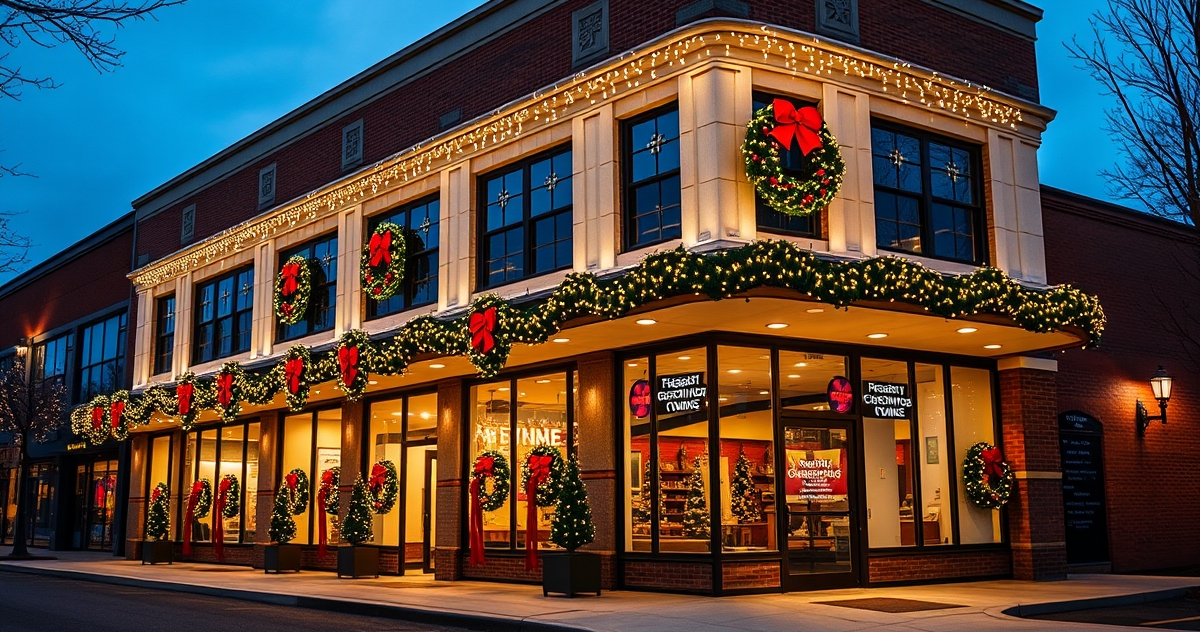
- Anchor Store Zone: High-visibility façade lighting using C9 strings along rooflines and canopies, oversized wreaths at primary entrances, and column garland with red bows. The goal is to make each anchor feel festive while maintaining the property's unified color palette of warm white, red, and green.
- Common Area Zone: Tree lighting in outdoor plazas, garland on railings and archways, and any permanent architectural features illuminated to draw shoppers toward the center's interior circulation paths. This zone creates the destination moments — the lit tree near the food court entrance, the garland-framed corridor — that shoppers photograph and share.
- Parking Lot Zone: Pole wraps and overhead string lighting transform an otherwise utilitarian space into part of the holiday experience. Warm white C9 strings run between parking lot light poles at 15–20 foot heights create a canopy effect that's visible from access roads and makes evening shopping feel safe and festive simultaneously.
The critical coordination challenge is ensuring that all three zones use compatible fixtures and color temperatures. Mixing cool white LED strings in the parking lot with warm white C9s on the canopy creates visual discord that undermines the premium feel a property manager is paying to achieve. A single professional contractor managing the entire property solves this problem by spec-ing consistent products across all zones before a single staple is driven.
Property managers overseeing office components within mixed-use developments should also review our office building holiday lights summer checklist for Pennsylvania property managers for additional coordination considerations.
Tenant Communication and Lighting Standards
One underestimated benefit of booking a professional lighting contractor early is gaining a partner who can help communicate lighting standards to tenants. When a shopping center establishes a property-wide color scheme — warm white, red, and green — and communicates it to tenants before September, individual storefronts can align their window displays accordingly. The result is a property that looks curated rather than chaotic. Our post on window display lighting techniques using wreaths, candles, and mini lights offers approaches that tenants can adapt for their own storefronts within the center's guidelines.
Pennsylvania Weather: Building Installations That Last the Season
Pennsylvania's holiday season weather is notoriously punishing on exterior lighting. From late November through January, properties across the state face freeze-thaw cycles, ice storms, heavy wet snow loads, and wind gusts that regularly exceed 30 mph. A shopping center that installs consumer-grade products — or hires an inexperienced contractor — will spend December making emergency repair calls rather than hosting holiday shoppers.
Professional commercial installations address Pennsylvania's climate through several specific practices:
- Commercial-grade C9 cords: 18-gauge SPT-2 wire rated for outdoor wet locations, not the lighter SPT-1 cord common in consumer products.
- UV-stabilized garland: Commercial garland with UV-treated PVC needles maintains its green color and structural integrity through Pennsylvania's full winter season without fading or brittling.
- GFCI-protected circuits: All exterior circuits installed with ground fault protection to handle wet conditions safely — non-negotiable in a public retail environment.
- Wind-rated mounting hardware: Wreaths and garland secured with commercial-grade attachment systems rated for sustained winds, not twist ties and zip locks.
- Seasonal inspection protocol: Reputable contractors include mid-season inspection visits to replace any failed bulbs, re-secure any wind-loosened elements, and ensure the display looks pristine through New Year's.
For a deeper look at how Pennsylvania's climate affects holiday lighting investments, our post on Pennsylvania weather and protecting your holiday lights investment covers weatherproofing strategies in detail.
How to Request a Commercial Site Assessment This Month
Requesting a commercial site assessment is the first concrete step toward securing a shopping center holiday lighting program for this season. A professional site assessment for a Pennsylvania shopping center typically covers five areas: property measurement and fixture-point mapping, power availability and circuit load analysis, product specification aligned with the property's aesthetic and budget, a phased installation timeline, and a written proposal with line-item pricing.
What to Prepare Before Your Assessment Appointment
Property managers who arrive at the assessment conversation prepared get faster, more accurate proposals. Before scheduling, gather:
- A site plan or aerial image of the property with anchor store locations marked
- The number and location of existing electrical service panels accessible for exterior circuits
- Any tenant lease requirements related to exterior modifications or lighting
- Last year's holiday lighting spend (if applicable) as a baseline for comparison
- Your preferred installation completion date (recommend targeting November 1–10 for Pennsylvania properties)
- Your color preference — warm white only, warm white with red accents, or a full warm white/red/green program
What a Professional Proposal Should Include
A credible commercial lighting proposal for a Pennsylvania shopping center should specify: exact product brands and specifications for C9 cords, wreath sizes, and garland density; circuit load calculations confirming power availability; a written installation timeline with weather contingency dates; a mid-season maintenance visit schedule; and takedown and storage terms for the following season. For context on how professional commercial service programs are structured, our commercial lighting services page outlines what a full-service program includes from assessment through removal.
Shopping centers that have never used professional lighting contractors sometimes underestimate the value of the removal and storage component. Having lights professionally removed, inspected, repaired as needed, and stored in climate-controlled conditions extends product life by 3–5 seasons — a meaningful factor when calculating total program cost. Our removal and storage service details how this works for commercial clients.
Frequently Asked Questions
When is the absolute latest a Pennsylvania shopping center can book holiday lighting and still get a quality result?
The realistic deadline for booking professional holiday lighting for a Pennsylvania shopping center and receiving a quality installation is September 15. After that date, premium installation slots — meaning experienced crews with lift access who can complete large-scale C9 and garland programs — are largely committed. Centers that book in October typically face limited product availability, compressed installation timelines, and higher labor costs. August booking remains the gold standard for full-service commercial programs.
What does a professional shopping center holiday lighting program typically cost in Pennsylvania?
Professional shopping center holiday lighting programs in Pennsylvania typically range from $8,000 to $45,000+ depending on property size, product scope, and whether the contract includes mid-season maintenance and removal. A mid-size center using C9 canopy strings, 12–16 commercial wreaths, and 400 linear feet of exterior garland generally falls in the $12,000–$25,000 range for a full-service program including installation, maintenance, and takedown. Early booking contracts frequently include 10–15% savings versus mid-season pricing.
How does a coordinated lighting program affect shopping center tenant satisfaction?
Shopping centers with professionally coordinated holiday lighting programs consistently score higher on tenant satisfaction surveys than those with uncoordinated or minimal décor. Tenants report that professional exterior lighting drives measurable foot traffic increases — particularly during evening shopping hours — and creates a festive atmosphere that benefits all retailers regardless of category. Many tenants factor property holiday presentation into lease renewal decisions, making the lighting program a retention tool as well as a marketing investment.
Can anchor store tenants have different lighting from the common area program?
Yes, but coordination is essential. The most successful shopping center programs establish a property-wide color palette — typically warm white with red and green accents — and allow tenants to add supplemental décor within those parameters. A professional lighting contractor can work with individual anchor store facilities teams to ensure tenant-specific additions don't clash with the property program. The key is establishing the standards in September, before tenants order their own products independently.
What happens if Pennsylvania weather damages the display mid-season?
Professional commercial lighting contractors include mid-season maintenance visits as part of full-service programs, typically scheduling inspections after major weather events. Commercial-grade C9 cords and mounting hardware used by professional installers are rated for Pennsylvania's freeze-thaw and wind conditions, significantly reducing failure rates compared to consumer-grade products. Most service contracts specify response times — commonly 24–48 hours — for repair calls during the active season, ensuring the property display stays pristine through the holiday period.
What's the best way to get a custom proposal for our shopping center?
The fastest path to a custom proposal is scheduling an on-site commercial assessment with Holiday Lights Decor Pennsylvania. During the assessment, a lighting specialist will walk the entire property, document measurement and power data, discuss your product preferences and budget parameters, and develop a written proposal typically delivered within 5–7 business days. This is a no-obligation process, and August assessments come with the benefit of full scheduling flexibility and the best available pricing of the season.
Pennsylvania shopping centers that move in August don't just get better scheduling — they get better displays, better pricing, and a competitive advantage during the most important retail stretch of the year. Whether your property is a neighborhood strip center or a regional anchor complex, the time to plan is now. Contact Holiday Lights Decor Pennsylvania today for a free commercial site assessment and custom holiday lighting proposal — and secure your installation date before the October rush closes your options.